As an Amazon Associate I earn money from qualifying purchases.

Tuesday, November 1, 2022

Nvidia GeForce RTX 3090 Specifications

It's hard to believe that Nvidia's GeForce RTX 3090 has been around for over two years now, though it has now been displaced by the new RTX 4090. You can see where the RTX 3090 ranks among other cards in our GPU performance hierarchy.

Originally launched in September 2020 alongside the RTX 3080, people complained about the price — how it was a Titan-class price without the Titan-class features like improved professional application drivers and support. And then the cryptocurrency mining boom of 2020 through 2022 hit, and suddenly $1,500 for an RTX 3090 that could potentially earn (at its highest point) over $30 per day seemed like a steal.

Naturally, prices shot up to compensate, scalpers got super involved with graphics cards, and the rest is sort of history. Painful history, at least for gaming enthusiasts — miners loved the RTX 3090. This was the fastest consumer graphics card throughout 2021, packed with features to make 4K gaming truly viable. And yet most of these cards probably spent all of 2021 chipping away in the Ethereum mines. RIP, Ethereum mining! But let's look at the specifications.

Nvidia GeForce RTX 3090 Specifications
ArchitectureGA102
Process TechnologySamsung 8N
Transistors (Billion)28.3
Die size (mm^2)628.4
Streaming Multiprocessors82
GPU Cores (Shaders)10496
Tensor Cores328
RT Cores82
Boost Clock (MHz)1695
VRAM Speed (Gbps)19.5
VRAM (GB)24
VRAM Bus Width384
L2 Cache6
Render Outputs112
Texture Mapping Units328
FP32 TFLOPS (Single-Precision)35.6
FP16 TFLOPS (Sparsity)142 (285)
Bandwidth (GB/s)936
Total Board Power (Watts)350
Launch DateSeptember 24, 2020
Launch Price$1,499

RTX 3090 uses the same GA102 chip as several other Nvidia GPUs — RTX 3080, RTX 3080 12GB, RTX 3080 Ti, and RTX 3090 Ti are all based off GA102. Back in 2020, there probably weren't that many nearly fully functional GA102 chips available, so supplies of the 3090 were quite limited and Nvidia pushed the narrative that these were "professional cards, not just for gamers." That's despite having GeForce branding right in the card name, so you can guess how well received such claims were.

With 82 of the available 84 SMs enabled, and the full 384-bit memory interface matched up with 24 1GB GDDR6X chips, this was a beast of a card. Power consumption on the reference model was rated at 350W, but third-party AIC vendors pushed things well into the 400W and higher range on factory overclocked cards.

One of the big issues with the RTX 3090, particularly for cryptocurrency miners, is that the GDDR6X chips ran hot. Fire up Ethereum mining and many 3090 cards, including the Founders Edition, would quickly reach 110C on the memory before starting to throttle. Dismantling the cards to replace the original thermal pads with better variants was common, and even in gaming workloads you could easily hit more than 100C on the memory.

The root of the problem was that, because Micron was only making 1GB (8Gb) capacity GDDR6X chips at the time, the RTX 3090 required half of the 24 chips to reside on the back of the PCB, while the other half were on the same side as the GPU. Take a look at that chunky Founders Edition up top: It has a chunky a triple-slot cooler to help keep all the chips cool... except that's only for the "front" of the PCB; the back of the PCB just has a metal cover with thermal pads and no active cooling. I can state from experience that the back of the card — with the RTX 3090 logo seen above, which usually faces upwards in most computer cases —can get extremely toasty under load!

Theoretical compute performance for the RTX 3090 tips the scales at 35.6 teraflops, and the Tensor cores can do up to 285 teraflops of FP16 with sparsity enabled. All of that number crunching prowess is put to good use in ray tracing games, and Nvidia's DLSS feature can leverage the Tensor cores to help with image upscaling that looks almost as good as native, at least in Quality mode. Almost all of the most demanding ray tracing games support DLSS, though, which actually brings 4K gaming into reach.

Nvidia GeForce RTX 3080 Ti Specifications

The Nvidia GeForce RTX 3080 Ti is the "poor man's" take on the RTX 3090. For gaming purposes, it delivers very similar performance as very few games actually use more than 12GB of VRAM. It uses the same GA102 GPU, only with 80 SMs instead of the 82 enabled in the RTX 3090. It also uses twelve 1GB (8Gb) GDDR6X memory chips rated for 19 Gbps. You can see where the RTX 3080 Ti ranks among other cards in our GPU performance hierarchy.

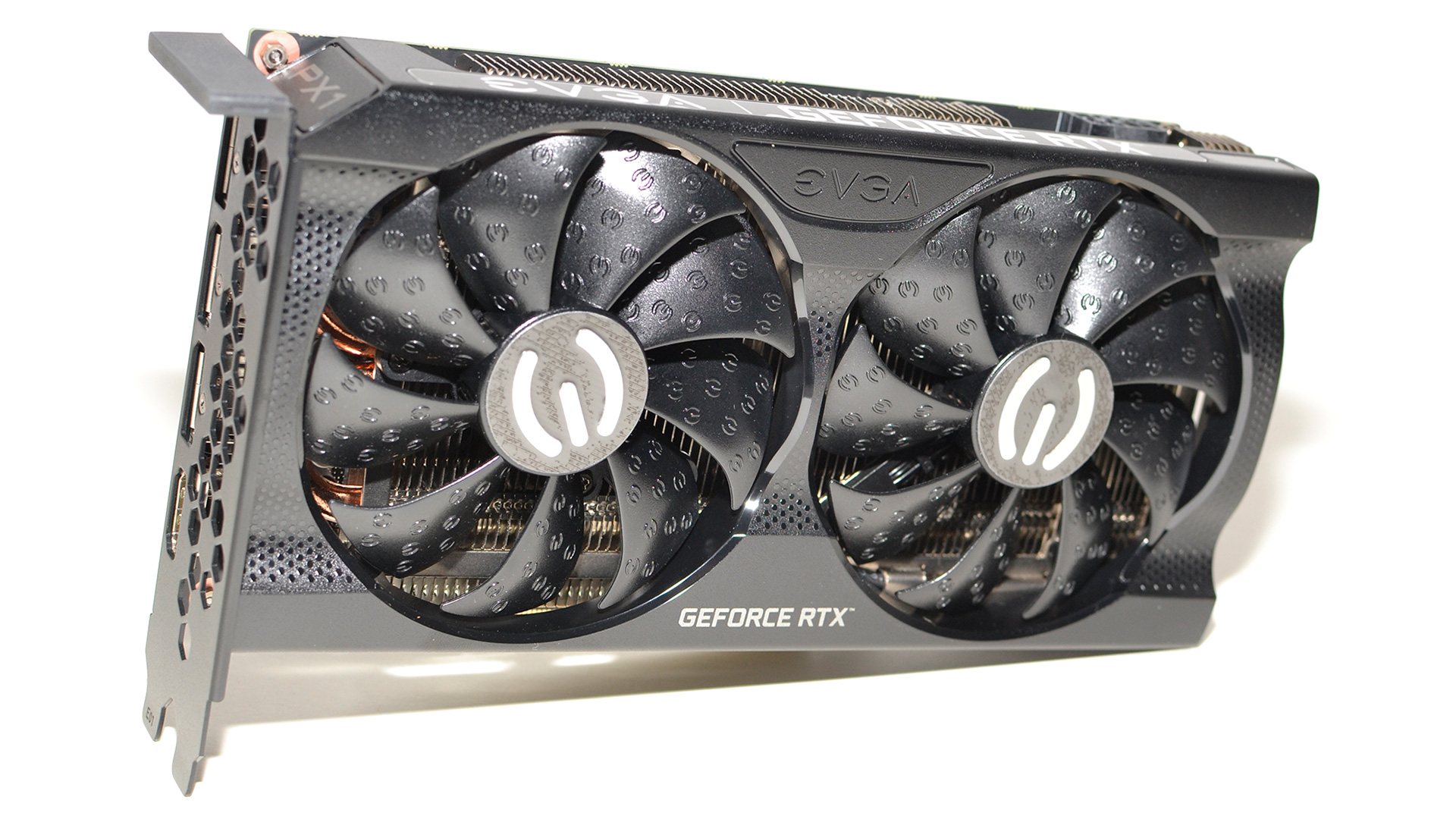
While the above image shows the RTX 3080 Ti Founders Edition, that's a very poor choice of card for the 3080 Ti. It has the same basic size and cooling capabilities as the RTX 3080, but with more cores and higher clockspeeds plus more GDDR6X chips, it runs very hot and gets quite loud. I recommend looking at the various AIC (add-in card) partner offerings for better 3080 Ti models.

Nvidia GeForce RTX 3080 Ti Specifications
ArchitectureGA102
Process TechnologySamsung 8N
Transistors (Billion)28.3
Die size (mm^2)628.4
Streaming Multiprocessors80
GPU Cores (Shaders)10240
Tensor Cores320
RT Cores80
Boost Clock (MHz)1665
VRAM Speed (Gbps)19
VRAM (GB)12
VRAM Bus Width384
L2 Cache6
Render Outputs112
Texture Mapping Units320
FP32 TFLOPS (Single-Precision)34.1
FP16 TFLOPS (Sparsity)136 (273)
Bandwidth (GB/s)912
Total Board Power (Watts)350
Launch DateJune 2, 2021
Launch Price$1,199

Launched about nine months after the Ampere architecture first arrived, the RTX 3080 Ti likely would have replaced the RTX 3080 in pricing, or perhaps it would have cost a bit more. However, the cryptocurrency boom of 2021 was in full swing and every graphics card was sold out. Nvidia opted to use a recommended price of $1,199, but all the cards immediately sold out and ended up going for closer to $2,000 — this despite the implementation of Nvidia's Lite Hash Rate (LHR) anti-Ethereum limiter, version 2.

Thankfully, the GPU shortages are behind us, and with RTX 40-series cards now starting to arrive, Nvidia and its partners have a glut of high-end RTX 30-series cards to sell. RTX 3080 Ti models often sell below $1,000, and short-term sales have seen prices as low as $700. With the RTX 4080 slated to launch on November 16, and likely an RTX 4070 or similar arriving by January that will at least match the performance of the RTX 3080 Ti, I wouldn't spend a ton of money on this sort of card right now.

Nvidia "unlaunched" the RTX 4080 12GB, but the AD104 GPU used in that card will almost certainly arrive in an RTX 4070 or 4070 Ti in the next couple of months. Such a card shouldn't cost much more than $599, and leaked benchmarks of the canceled RTX 4080 12GB suggest it would be at least as fast as the 3080 Ti — plus with support for DLSS3, improved ray tracing hardware, and with lots of L2 cache to mitigate the relatively narrow memory bus.

Nvidia GeForce RTX 3080 12GB Specifications

The GeForce RTX 3080 12GB is a rather curious card — you can see how it stacks up in our GPU performance hierarchy. It first appeared without any fanfare, right as the cryptocurrency bubble was starting to burst. Nvidia never released its own version of the 3080 12GB, stating that it was a GPU model requested by its AIC (add-in card) partners. Whether that's true or not, no one may know, but we do know how things played out.

Nvidia didn't give an official MSRP for the RTX 3080 12GB, which mean AIC vendors could set their own prices. It also meant Nvidia wouldn't be beholden to an MSRP set back in 2020 before the cryptocurrency boom caused GPU prices to skyrocket. At launch, these were very nearly the same as the RTX 3080 Ti. Specifications meanwhile end up being a blend of what you get from the existing RTX 3080 (10GB) and the 3080 Ti.

Nvidia GeForce RTX 3080 12GB Specifications
ArchitectureGA102
Process TechnologySamsung 8N
Transistors (Billion)28.3
Die size (mm^2)628.4
Streaming Multiprocessors70
GPU Cores (Shaders)8960
Tensor Cores280
RT Cores70
Boost Clock (MHz)1845
VRAM Speed (Gbps)19
VRAM (GB)12
VRAM Bus Width384
L2 Cache6
Render Outputs96
Texture Mapping Units280
FP32 TFLOPS (Single-Precision)33.1
FP16 TFLOPS (Sparsity)132 (264)
Bandwidth (GB/s)912
Total Board Power (Watts)320
Launch DateJanuary 11, 2022
Launch Price~$1,000

The 3080 12GB has 70 SMs enabled, compared to 80 on the 3080 Ti and 68 on the 3080 10GB. More importantly, perhaps, it has all twelve GDDR6X channels enabled. That means users get 20% more VRAM, along with 20% more memory bandwidth. Given AMD's push to put more VRAM in its RX 6000-series GPUs, some viewed this as a way to close the gap between the 3080 and the RX 6800 XT.

Of course there's more to the story than just the raw specs. Miners seem to have acquired quite a few 3080 12GB cards — this despite the use of a new LHR (Lite Hash Rate) limiter. We can only assume the biggest mining groups already had software that would circumvent Nvidia's LHR, and unlocked mining performance would have been effectively as good as the RTX 3080 Ti and RTX 3090.

The 3080 12GB also filled a gap in new product launches for Nvidia, as the at-the-time new RTX 3050 marked the end of the line for RTX 30-series products. RTX 3090 Ti was "coming soon" but would cost even more money, the future RTX 40-series was a long way off, and Nvidia likely had plenty of chips with twelve fully functional memory controllers that had too many defective SMs to qualify as 3080 Ti or higher GPUs.

At present, the RTX 3080 12GB tends to be a bit overpriced. The cheapest one goes for $809 on Amazon at the time of writing, over $100 more than the cheapest RTX 3080 10GB at $699. It's also about $165 less than the cheapest RTX 3080 Ti at $975. The problem is that all of these cards are currently overpriced!

Last year, paying under $1,000 for any of these GPUs was virtually unheard of, but now there's a reported glut of 3080 and 3090 graphics cards waiting to be sold. We also have the new RTX 4090 at $1,599, with the RTX 4080 slated to launch on November 16 at $1,199. Both will offer significantly more performance and a bunch of extra new features like DLSS3 Frame Generation, and the RTX 4070 will probably land in January at a price of $599 or less.

If you love the idea of an RTX 30-series card with 12GB VRAM, try to wait until you can pick one up for $500 or less. That might mean going through eBay, but at least you won't be paying way too much money for technology that's over two years old!

Nvidia GeForce RTX 3080 (10GB) Specifications

The Nvidia GeForce RTX 3080 — the original 10GB model, not the later 12GB variant — was theoretically the best graphics card of the past generation. In practice, component shortages and especially cryptocurrency mining made it nearly impossible to find the RTX 3080 at a price even remotely approaching reasonable. Except plenty of gamers did buy the RTX 3080 for gaming; they just mined on the side to help cover the cost.

You can see how the RTX 3080 ranks in our GPU performance hierarchy, where it's currently in seventh place overall. Of course, it's bound to fall quite a bit in the next month or so as the RTX 4080 and various AMD RDNA 3 GPUs start to arrive. Right now, the RTX 3080 starts at a price of $699 on Amazon, so it's finally selling at MSRP, but it was going for $1,500–$2,200 for most of 2021. Thank goodness Ethereum has gone proof of stake at least and put a nail in the coffin of GPU miners.

Nvidia GeForce RTX 3080 Specifications
ArchitectureGA102
Process TechnologySamsung 8N
Transistors (Billion)28.3
Die size (mm^2)628.4
Streaming Multiprocessors68
GPU Cores (Shaders)8704
Tensor Cores272
RT Cores68
Boost Clock (MHz)1710
VRAM Speed (Gbps)19
VRAM (GB)10
VRAM Bus Width320
L2 Cache5
Render Outputs96
Texture Mapping Units272
FP32 TFLOPS (Single-Precision)29.8
FP16 TFLOPS (Sparsity)119 (238)
Bandwidth (GB/s)760
Total Board Power (Watts)320
Launch DateSeptember 17, 2020
Launch Price$699

Unlike the new Ada Lovelace RTX 4090 and RTX 4080, the RTX 3080 uses the same GA102 GPU as the RTX 3090, as well as the more recently released RTX 3080 Ti and RTX 3090 Ti. It has 68 of the potential 84 SMs enabled, so only 81% of the GPU shaders are functional. Similarly, it only has 10 of the potential twelve 32-bit GDDR6X memory controllers enabled — 83% of the total.

Not surprisingly, the performance ends up being around 87% of the fully enabled RTX 3090 Ti. If we were only looking at MSRPs, that would make the RTX 3080 an excellent option, but in practice the prices on RTX 3080 Ti through RTX 3090 Ti have all dropped. There's also the RTX 3080 12GB that came out in early 2022, which currently starts at $809 on Amazon. The extra VRAM might be tempting, but do keep in mind we're likely to see RTX 4070 by January at latest, which will probably cost $599 and will easily outperform either the 10GB or 12GB 3080 cards.

It's sad that the replacement RTX 4080 has taken over the price point of the RTX 3080 Ti, but again we may see prices fall in the coming months. Nvidia and its partners are trying to clear out existing inventory on Ampere / RTX 30-series graphics cards, and they're supposedly on track to have that job finished by January. Once Nvidia no longer has to protect prices on existing cards, and once AMD's competing RX 7000-series cards start to ship, we could easily see prices on the RTX 4080 drop well below $1,000 — and at that point, RTX 3080 cards will have a tough time selling for even $500.

Consider this: Even if TSMC's 4N wafers costs Nvidia $20,000 each (which is unlikely, as volume orders mean Nvidia is probably paying $15,000 or less per wafer), the cost per AD104 chip (RTX 4070) is still relatively low. Nvidia can get around 190 die per wafer, which at $20,000 would be just $105 per chip. Even after packaging and everything else, that's probably only $150. Add the PCB, VRAM, cooler, and all the various surface mounted devices (capacitors, resistors, etc.) and the total cost might be $300. Nvidia could absolutely sell such a GPU at $500 and make money, so the nonsense with the RTX 4080 12GB being priced at $899 was purely a money grab, and Nvidia walked back on that due to enthusiast outrage.

As for the RTX 3080 10GB, Samsung's 8N wafers are going to cost Nvidia a lot less than TSMC 4N wafers. Let's call it $5,000, which is probably still being generous as 8N is really just a tuned 10nm Samsung Foundry process node. GA102 is a big chip at 628.4mm2, but Nvidia can still get around 88 chips per wafer after harvesting. At $5,000 per wafer, that's only $57 per chip. Add in PCB, VRAM, cooler, and the other bits and pieces and the cost is probably $200–$250 at most. But Nvidia doesn't want to continue to sell RTX 3080 cards, so they'll be phased out shortly — even if that means clearance pricing on Black Friday for whatever cards are still around.

Nvidia GeForce RTX 3070 Ti Specifications

The Nvidia GeForce RTX 3070 Ti was a product of its time, much like its big brother RTX 3080 Ti. If it hadn't been released during a GPU shortage, it probably would have taken over the $499 price point that the RTX 3070 was supposed to occupy. Instead, it had to stake its claim to the middle ground between the RTX 3080 and 3070, but the official pricing was nonsense until the latter part of 2022.

Besides the price, the RTX 3070 Ti had other problems, like the fact that it was only about 6% faster than the RTX 3070 — that's according to our GPU performance hierarchy — but its power use was 32% higher thanks in part to its use of GDDR6X memory. Nvidia also pushed up the power budget so that the GPU could clock higher, but even then, typical clocks while gaming weren't any higher than on the vanilla 3070. That means nearly all of the increased power budget was actually going to the VRAM.

Nvidia GeForce RTX 3070 Ti Specifications
ArchitectureGA104
Process TechnologySamsung 8N
Transistors (Billion)17.4
Die size (mm^2)392.5
Streaming Multiprocessors48
GPU Cores (Shaders)6144
Tensor Cores192
RT Cores48
Boost Clock (MHz)1765
VRAM Speed (Gbps)19
VRAM (GB)8
VRAM Bus Width256
L2 Cache4
Render Outputs96
Texture Mapping Units192
FP32 TFLOPS (Single-Precision)21.7
FP16 TFLOPS (Sparsity)87 (174)
Bandwidth (GB/s)608
Total Board Power (Watts)290
Launch DateJune 10, 2021
Launch Price$599

The core specs are naturally slightly higher than the RTX 3070. The 3070 Ti uses the fully enabled GA104 chip, with 48 SMs and 6,144 GPU shaders. That's still only a 4% increase over the 3070's 36 SMs. Even factoring in the supposedly higher clocks, it's just a 7% improvement.

The bigger change is of course the move from GDDR6 to GDDR6X, which boosted memory bandwidth by 36%. If the GA104 was bandwidth starved, that would have delivered a major increase in performance, but clearly that's not the case. Even in the most demanding ray tracing games, performance is only around 10% faster than the 3070.

The bigger issue for the RTX 3070 Ti and Nvidia's Ampere GPUs was that it needed to populate a 256-bit memory interface to get the advertised bandwidth, so Nvidia had to decide between 8GB using eight 8Gb GDDR6X chips, or 16GB using eight 16Gbps GDDR6X chips (which might not have even been ready at the time). With the GPU shortages in full force, Nvidia took the cheap route and we got a mediocre "upgrade" that was still sold out.

The 3070 Ti and RTX 3080 Ti were the second Ampere GPUs (after the RTX 3060) to include the LHR (Lite Hash Rate) limiter. It may or may not have worked properly, but mostly it probably just stopped smaller miners from using the card — all indications are that larger mining farms already had ways around the LHR lock.

Today, the RTX 3070 Ti still starts at $629 on Amazon. Maybe it was worth that much earlier in the year, but with an RTX 4070 right around the corner, it would be stupid to pay that much money for a card that will soon be relegated to the midrange performance tier.

Nvidia GeForce RTX 3070 Specifications

The Nvidia GeForce RTX 3070 was supposed to be the chosen one. Nvidia's 70-class GPUs (meaning, 2070, 1070, 970, etc.) are typically the best blend of price and performance. On paper, there was a lot to like with the RTX 3070. It could match the performance of the outgoing RTX 2080 Ti, it only needed 220W of power, and it was only supposed to cost $499. GPU shortages and spiking cryptocurrency prices nuked any thought of reasonable pricing, unfortunately, and the 3070 sold for over $1,000 for most of its life.

The RTX 3070 also represented a rather large step down in theoretical and real-world performance compared to the RTX 3080 (10GB). You can see in our GPU performance hierarchy that it's 18% slower than the 3080, for 29% less money (in theory). In practice, it was more like $1,200 versus $2,000, a 40% drop in pricing, but that's because the 3070 was 33% slower at Ethereum mining. Thankfully, prices have come down a lot since 2021, though with RTX 4090 now here, RTX 4080 launching soon, and an RTX 4070 likely to show up by January, the RTX 3070's days are numbered.

Nvidia GeForce RTX 3070 Specifications
ArchitectureGA104
Process TechnologySamsung 8N
Transistors (Billion)17.4
Die size (mm^2)392.5
Streaming Multiprocessors46
GPU Cores (Shaders)5888
Tensor Cores184
RT Cores46
Boost Clock (MHz)1725
VRAM Speed (Gbps)14
VRAM (GB)8
VRAM Bus Width256
L2 Cache4
Render Outputs96
Texture Mapping Units184
FP32 TFLOPS (Single-Precision)20.3
FP16 TFLOPS (Sparsity)81 (163)
Bandwidth (GB/s)448
Total Board Power (Watts)220
Launch DateOctober 10, 2020
Launch Price$499

The RTX 3070 was the first Nvidia Ampere GPU to use GA104, a change from GA102 in the RTX 3090 and RTX 3080. It's a much smaller die size, 38% smaller to be precise, meaning Nvidia can get a lot more chips per wafer. At a rough estimate, Samsung's 8N process yields around 86 GA102 chips per wafer versus 144 GA104 chips.

We figure the wafer price is probably only $5,000 to $7,000, which means the chip cost on RTX 3070 is only $35–$49. That's not the only cost, naturally, so everything else likely adds up to around $200–$250. The retail price is double that, ensuring a healthy profit margin, but with crap like GPU mining going nuts the cards were going for 4x to 5x that much last year.

We've seen the generational pricing on the 70-class GPUs creep up steadily over time. GTX 770 was a $399 part at launch that later dropped to $329. The GTX 970 launched at $329. Then the GTX 1070 pushed things up to $449 for the Founders Edition with a $379 MSRP on the cheapest third-party cards. RTX 2070 increased it to $499 for the Founders Edition and third-party cards.

We sort of stayed there with the RTX 3070, but given the higher 20-series pricing came right after the last time there was a cryptocurrency bubble, it wouldn't be at all surprising if Nvidia were to raise the RTX 4070 launch price to $599. It's not what we want to happen, and perhaps AMD will put up a strong enough competitor that Nvidia won't go that high... but it's certainly in the realm of the possible.

Nvidia GeForce RTX 3060 Ti Specifications

The Nvidia GeForce RTX 3060 Ti represents a new tier in Nvidia's range of GPUs — or alternatively, it's a replacement for the RTX 2060 Super tier. You can check our GPU performance hierarchy to see where it lands, but the short summary is that it's only about 8% slower than the RTX 3070.

The odd thing about the 2060 Super comparison is that the various 20-series Super cards were a refresh that occurred roughly a year after the initial 20-series launch. The 30-series Ti cards are mostly refreshes of existing cards as well — RTX 3070 Ti and RTX 3080 Ti came out around 10 months after the non-Ti versions first appeared, while the RTX 3090 Ti came out 18 months after the RTX 3090. The 3060 Ti was basically a way to stretch out the range of performance offered by Nvidia's Ampere GPUs compared to Turing.

Did that 'experiment' on naming work out well for Nvidia? We don't really know, and all the stats on sales and prices from the 30-series are borked thanks to cryptocurrency mining. The 3060 Ti was basically the same mining performance as the RTX 3070, since they both use 8GB of GDDR6 memory, so both ended up selling in the $1,000–$1,200 range through most of 2021. That was up to triple the recommended price!

RTX 4090, RTX 4080, and RTX 4070 are here or at least on the way, and there will be an RTX 4060 and RTX 4050 as well. But will there be Ti, Super, or some other name for in-between cards? And will those cards launch alongside the vanilla versions, or will they be the one year later refreshes like we've seen in the past? We'll find out in the coming months.

Nvidia GeForce RTX 3060 Ti Specifications
ArchitectureGA104
Process TechnologySamsung 8N
Transistors (Billion)17.4
Die size (mm^2)392.5
Streaming Multiprocessors38
GPU Cores (Shaders)4864
Tensor Cores152
RT Cores38
Boost Clock (MHz)1665
VRAM Speed (Gbps)14
VRAM (GB)8
VRAM Bus Width256
L2 Cache4
Render Outputs80
Texture Mapping Units152
FP32 TFLOPS (Single-Precision)16.2
FP16 TFLOPS (Sparsity)65 (130)
Bandwidth (GB/s)448
Total Board Power (Watts)200
Launch DateDecember 2, 2020
Launch Price$399

We talked about the upward creep in generational pricing tiers in our RTX 3070 overview. With RTX 3060 Ti, this was sort of the "real" 70-class replacement if we go back to the GTX 1070 era. (The RTX 2070/2070 Super already pushed the 70-class into the $500 range.) The RTX 3060 Ti uses the same GA104 chip as the 3070, and it has the same amount of memory, so the cost for the hardware is pretty much identical. That means Nvidia makes money selling GA104-based cards for $399, so the 3070 is just an extra $100 in pure profit on some levels (spread among Nvidia, AIC partners, distributors, and retailers).

Besides reducing the SM count down to 38 (from 46 on the 3070), the only other significant change was the drop in power from 220W to 200W. The official boost clock is also 60 MHz slower, but in practice that hardly matters. Running some gaming tests as an example, the 3070 Founders Edition clocked at 1863 MHz while the RTX 3060 Ti Founders Edition clocked at 1900 MHz on average. Yes, you got that right: The theoretically lower clocked part hit higher boost clocks under real-world testing.

Which is where the upcoming RTX 40-series parts are very interesting. Let's quickly look at the past several generations of architectures. Starting with the GTX 900-series, Nvidia's Maxwell architecture only had average clocks of around 1,210 MHz (for reference cards where possible). Nvidia's GTX 10-series Pascal architecture bumped that up a lot, with average gaming clock in the 1,800 MHz range. Turing RTX 20- and GTX 16-series GPUs barely changed things, averaging 1,870 MHz. Ampere RTX 30-series was a similar story, with a relatively minor speed bump up to 1,900 MHz.

Now look at the RTX 40-series. Advertised boost clocks so far are in the 2.5–2.6 GHz range, while real-world clocks on the RTX 4090 Founders Edition are above 2,700 MHz. Imagine an RTX 4060 with a few more GPU shaders and SMs, clocked 40% higher than the 3060 Ti. We'd be looking at a 50% generational boost in performance. Or in other words, there's a good reason to wait rather than trying to pick up an RTX 3060 Ti at this late stage in its life cycle.

Nvidia GeForce RTX 3060 (12GB) Specifications

The Nvidia GeForce RTX 3060 — that's the 12GB version, now that there's a crappy 8GB model — is easily the most popular option from the Ampere generation of GPUs. That's no surprise, since the GTX 1060 has been legendary in the Steam Hardware Survey and still takes the top spot, though do note that the 1060 includes both 3GB and 6GB variants as well as the mobile models all clumped under one name. RTX 2060 comes in second, then the GTX 1650, but the desktop RTX 3060 sits in fourth place overall. Our GPU performance hierarchy shows how the 3060 stacks up against the competition, and at the official $329 MSRP there should be plenty to like.

Except the RTX 3060 has basically never sold at MSRP in large quantities, and even now the RTX 3060 starts at around $359. That's a 20 month old card, where the base price remains about 10% higher than it "should" be, and plenty of cards are still selling for close to $400. Throughout 2021, the RTX 3060 tended to sell for $600 or more thanks to cryptocurrency mining.

The online prices put the RTX 3060 into direct competition with AMD's RX 6700 10GB (the non-XT card) as well as Intel's Arc A770 16GB. News flash: It loses both of those matchups in a lot of games. It's only with ray tracing and DLSS that you can sort of make a good argument for the 3060.

With the RTX 4090 here, RTX 4080 coming in a couple of weeks, and RTX 4070 likely landing in January, there's also the question of when the RTX 4060 will arrive — and how much it will cost. We'd peg the card for a spring launch, though it might come a bit earlier if Nvidia can manage to clear its warehouses of all the existing RTX 3060, RTX 3060 Ti, and RTX 3070 cards.

Nvidia GeForce RTX 3060 Specifications
ArchitectureGA106
Process TechnologySamsung 8N
Transistors (Billion)12
Die size (mm^2)276
Streaming Multiprocessors28
GPU Cores (Shaders)3584
Tensor Cores112
RT Cores28
Boost Clock (MHz)1777
VRAM Speed (Gbps)15
VRAM (GB)12
VRAM Bus Width192
L2 Cache3
Render Outputs48
Texture Mapping Units112
FP32 TFLOPS (Single-Precision)12.7
FP16 TFLOPS (Sparsity)51 (102)
Bandwidth (GB/s)360
Total Board Power (Watts)170
Launch DateFebruary 25, 2021
Launch Price$329

The RTX 3060 bumps the price a bit relatively to the later $299 MSRP on the RTX 2060, as well as the GTX 1060 6GB. If we could have purchased cards at that price last year, though, we would have been ecstatic. Today? We're not quite so thrilled.

The best part about the RTX 3060 is that it comes with 12GB VRAM on a 192-bit interface. That's more than the 3060 Ti through 3080 10GB, though with less raw bandwidth. The memory even comes with a higher 15 Gbps clock to help increase the bandwidth. Interestingly, the next-generation Ada Lovelace replacement might drop down to a narrower interface, taking the AMD route and increasing effective bandwidth with lots of L2 cache. The thing is, after the 3060 shipped with 12GB standard, Nvidia will have a hard time convincing anyone that less than 12GB is sufficient for a midrange or higher GPU.

TBP sits at a reasonable 170W, and with a boost clock of 1,777 MHz the 3060 delivers up to 12.7 teraflops of FP32 compute — and 102 teraflops via the Tensor cores. In our actual gaming tests, we saw average clocks of around 1,875 MHz, meaning the real-world teraflops is 13,4. The RX 6700 by comparison sits at 11.3 teraflops, though AMD doesn't have the split FP32 and FP32+INT32 to contend with, meaning the performance per teraflops tends to be a bit better than on Ampere.

Nvidia GeForce RTX 3050 Specifications

The Nvidia GeForce RTX 3050 was the final "real" addition to the Nvidia Ampere family, unless you want to count the belated RTX 3090 Ti or the recently added RTX 3060 8GB. It's also one of the least desirable of the RTX class of cards, failing to outperform the previous generation RTX 2060 in most situations — check our GPU performance hierarchy for the full details.

The idea behind the RTX 3050 seems sound enough: Bring RTX features to a new, lower price point. The RTX 2060 bottomed out at $299 for a while, though you can now buy RTX 2060 for just $269, and we've seen it go for as little as $219. The RTX 3050 meanwhile has continued to sell for $299 or more. That would be bad enough, but the AMD competition for the best mainstream GPU is fierce, and the RX 6600 at just $219 walks all over the RTX 3050. Okay, maybe not in ray tracing games, but that's about the only saving grace for the 3050.

We'll eventually get an RTX 4050, but the 3050 is less than a year old so it's not due for replacement for another year. And if foolish people keep paying $300 or more for the card, Nvidia won't be in any hurry to push the Ampere cards to end of life status. Anyway, let's hit the specs.

Nvidia GeForce RTX 3050 Specifications
ArchitectureGA106
Process TechnologySamsung 8N
Transistors (Billion)12
Die size (mm^2)276
Streaming Multiprocessors20
GPU Cores (Shaders)2560
Tensor Cores80
RT Cores20
Boost Clock (MHz)1777
VRAM Speed (Gbps)14
VRAM (GB)8
VRAM Bus Width128
L2 Cache2
Render Outputs48
Texture Mapping Units80
FP32 TFLOPS (Single-Precision)9.1
FP16 TFLOPS (Sparsity)36 (73)
Bandwidth (GB/s)224
Total Board Power (Watts)130
Launch DateJanuary 26, 2022
Launch Price$249

The RTX 3060 comes with 8GB of VRAM, but it's on a 128-bit interface and that means total bandwidth is less than on the previous generation RTX 2060. There are a few edge cases where the extra VRAM may overcome the bandwidth deficit, but you'd be better off dropping your settings a bit to fit a game into the 2060's 6GB.

Raw compute comes in at 9.1 teraflops, compared to 6.5 teraflops on the 2060. However, that's a bit misleading as the Ampere teraflops are shared between FP32 and INT32 while the Turing generation has dedicated INT32 SIMD units. Also, it's 224 GB/s of bandwidth for the 3050 versus 336 GB/s on the 2060, which might be the bigger issue.

TBP does come in below the 2060's 160W, with the 3050 only requiring 130W. But let's also not forget the 132W RX 6600 with 8.9 teraflops of compute and 224 GB/s bandwidth paired with a 32MB Infinity Cache. Bottom line: AMD's RX 6600 easily wins any meaningful comparisons, unless you only play games that support DLSS (but not FSR2).

Monday, May 3, 2021

Chia Coin Trading Is Live, Mass Storage Shortages Could Follow (Or Not)


After a month of waiting, newcomer cryptocurrency Chia has finally hit it's trading start date. It's not listed at many exchanges yet, and there are lots of concerns and caveats with jumping on any new cryptocoin. But Chia is going for a novel appoach with a new proof of space and time algorithm. It's supposed to be far more environmentally friendly than all the proof of work coins like Bitcoin and Ethereum, but it could also shake up the storage industry in a big way.

Instead of hashing, Chia uses large plots of numbers that effectively amount to a massive Bingo card. The network determines the winning criteria every 20 seconds or so (18.75s, theoretically?), and that plot gets 2 XCH, the abbreviation for Chia's coin. The blockchain and block reward structure ends up similar to other cryptocurrencies, but the creation of the plot is the only really difficult part. After that, it's just a matter of letting the Chia plots sit around on your storage devices and hoping one of them gets a 'hit' every now and then.

I hesitate to even mention the current pricing, as it's extremely volatile right now. Early guesstimates put the starting price of XCH at $20, but IOUs for when trading commenced already hit the $1,000 mark in April. So far, we've seen a high of $1,935 today and a low of $1,116. Given the current statistics, neither price is remotely sustainable. Unless...

Yeah, unless. If you asked me years ago what Bitcoin would be worth, I would have never landed at it hitting $50,000 per BTC. Others were more prescient. People asked me about Ethereum when it launched, and I had reached the jaded point of seeing too many scam coins and ICOs and felt it was nothing special. Now, those who took the risk on the ICO have seen its value increase by 10,000X. There are a ton of other coins that haven't done nearly so well, and lots of scams as well, but Chia has some well-known people behind it. As in, Bram "BitTorrent" Cohen. Yeah, the guy that helped create BitTorrent is deeply involved in Chia. Which, I don't know ... BitTorrent isn't exactly a warm fuzzy term. It's useful for a lot of things, but also has been used for a ton of illegal downloads. Whatever.

Let's talk some theoreticals, then. The current netspace used by Chia — which is basically the Chia equivalent of the network hashrate — is already at an astounding 1.77 EiB. That's exbibytes, as in binary exabytes, or 2^60. It's a huge number, in other words. You'd need 177,000 10TB HDDs to store all that data. Even more alarming: Chia's netspace has basically doubled in the past week, and doubled again during the week before that.

Now that XCH is a tradable commodity on a cryptocurrency exchange, the price will help determine the eventual resting point for how much netspace it will use. Right now, even if we go with $1,000 per XCH, you could theoretically earn $1,500 per month from a single 10TB hard drive (#affiliate)! But that's only part of the story.

Creating Chia plots requires about 2.7TB of data to be written. It takes a decent amount of time on a hard drive, but a fast SSD can work on multiple plots concurrently. Except, 2.7TB of writes will burn through the life expectancy of most SSDs! This is where an enterprise class SSD could make a lot of sense. Anyway, if you want to do a lot of Chia plots quickly, you'll need a decent CPU with sufficient RAM, and then an ultra-fast SSD with a high endurance rating. Intel's Optane 905p 960GB for example would be a great choice. Or get an enterprise Intel DC P3600 1600GB drive for $1250. That should allow for the creation of eight concurrent plots in perhaps five hours, or 40 plots per day.  Let's just call it 20 plots per day to be conservative — and Chia will move those plots from temporary creation storage (ie, your fast SSD) to slower long-term storage (ie, a cheap HDD) automatically.

Here's the catch: Right now, Chia farming is basically all done solo. There are mining guilds of a sort, but they're not something I'd recommend — they require you to give away the keys to the kingdom (your private wallet keys). Pooled mining (farming) of Chia is supposed to be coming, but it's not here yet. So in order to win let's just say one plot per week, you'll need ... wait for it ... about 50TB worth of stored Chia plots. Ouch. And that's before the inflation in Chia's netspace, which will drop your mining rewards proportionately.

Now we're looking at $1250 worth of hard drives, plus a $1250 fast enterprise SSD, to do around 20 Chia plots per day. It will take over a week to fill up the HDDs with plots, at which time the netspace has potentially doubled again. That's a very ugly cycle!

Ultimately, the price or netspace (difficulty, sort of) have to reach equilibrium. An RTX 3090 graphics card selling at $3000 (twice its official launch price) can each about $10 per day, so 300 days to break even. Chia farming at $1000 per XCH will potentially get you $1000 per month per 10TB HDD, with a cost of $250 or so per drive. What's more, the power required to keep those drives online is nominal compared to GPU or ASIC farming — about 10W max per 10TB, vs. 250W for a high-end GPU.

Where will Chia and XCH stabilize, and where will they be in a year? Without a lot of storage, it's going to be difficult to get started right now due to the solo mining approach, but when pooled mining becomes available things will likely get a lot better. 10TB of storage could easily net you over $1000 by next year, possibly much more. Or it could end up being wasted space and wasted write cycles on your SSDs.


One final item of note is that Chia has a premine — or in this eco-friendly coin market, a pre-farm. Chia calls this the "Strategic Reserve" and it's a whopping 21 million XCH. That's right: the creators already have 21 million Chia waiting to be utilized. Now, a premine isn't the end of the world, as the funds from such can be used for marketing, development, etc. Lots of successful coins have had a premine or ICO. But it does mean that at the current price of $1000+, a brand new coin would have a theoretical market cap of $21 billion.

Outside of the pre-farm, to date only 451K XCH have been farmed. So of all XCH currently in existence, 98% came via the pre-farm. At a rate of 64 XCH per 10 minutes from farming, for the first three years (the block rewards will halve every three years, until reaching a steady rate of 4 XCH per ten minutes after 12 years), after the first three years the farmed XCH will only account for 32.5% of all XCH in existence. In another three years, farmed XCH will represent 41.9% of all XCH. In fact, it will take approximately 21 years for the farmed XCH to surpass the total size of the initial pre-farm.

In other words, no matter how much money Chia farmers make off of XCH in the coming years, it will be dwarfed by the amount that the Chia Network 'company' makes. Keep that in mind. The people who stand to gain the most from Chia doing well already have control of millions of XCH.

And let's end where I started. The price of XCH now, just an hour or two after I began, has now dropped to just over $1000. It could fall a lot further!

Addendum: The next morning, it looks like prices have reached relative stability at around $750.